Organic vs. OEKO-TEX: What's the Difference, and Why It Matters
One of the most common sources of confusion in the baby-clothing world is the language on the labels. Terms like organic cotton, natural fibres, and certified safe are often used side by side, and it is easy to assume they all mean the same thing. They do not. An organic label and a finished-product safety certification answer two genuinely different questions, and understanding the difference helps you choose with clear eyes rather than guesswork. Within the intentional lifestyle persona of GLYN & CO., we believe in plain transparency about what a certification does and does not cover. This article explains what organic certification actually regulates, what OEKO-TEX Standard 100 actually tests, and why both are meaningful in their own ways.
The short version is this: organic certification is mainly about how a fibre is farmed, while OEKO-TEX Standard 100 is about what is, or is not, present in the finished garment. Neither is a substitute for the other, and neither is automatically superior; they simply look at different points in a textile's journey. To explore these distinctions in more depth, exploring the archive of The GLYN Journal offers grounded, honest writing about how textiles are made and tested.
It helps to start with why the fabric a baby wears is worth choosing thoughtfully. A newborn's skin is gentler and more delicate than an adult's, and any garment is in close contact with it for much of the day. As established in clinical histological studies of infant epidermis development, the outer layer of newborn skin is less developed than a mature adult's, with skin cells that are smaller and arranged less tightly together. Because this outer layer is more delicate in early infancy, a soft, gently finished, independently tested fabric is a thoughtful choice for the layer closest to your baby.
The outer layer of the skin also acts as its natural surface barrier. As analysed in peer-reviewed research on neonatal skin barrier function, infant skin tends to lose water more readily than mature adult tissue because its protective layers are still developing. This is part of why the qualities of the finished fabric, its softness, breathability, and what it has been tested for, matter so much, and why we focus on finished-garment certification.
A baby's skin also gradually settles into its own natural balance over the first weeks of life, sometimes described as the development of the acid mantle, moving from a near-neutral surface toward a slightly acidic one, which supports the healthy development of the skin's microbiome. A gentle, breathable, well-made fabric simply supports the calm environment a baby is most comfortable in. With that context, the two kinds of certification make more sense.
Organic certification is a genuinely valuable agricultural standard. It governs how a fibre such as cotton is grown, with frameworks focused on soil management, crop rotation, and restrictions on synthetic pesticides, genetically modified seeds, and certain agricultural chemicals. This matters for the environment and for the people who farm the land, and it reduces the use of synthetic inputs in cultivation. It is a meaningful, worthwhile standard for the world our children will grow up in.
What organic certification is primarily designed to track, though, is the growing of the fibre, the early stages of the supply chain. A baby's skin never touches the raw plant in the field; it touches the finished, processed fabric. Between the field and the finished garment, a textile is spun, washed, dyed, finished, and sewn. An organic-fibre label tells you about the origin of the fibre, which is genuinely useful, but on its own it is not designed to confirm what is present in the final, finished garment after all that processing.
This is exactly the gap that finished-product testing is built to address. Because so much happens between field and finished piece, a separate question is worth asking: what, if anything, remains in the garment that will actually sit against the skin? A standard content label declares the fibre content, but it is not designed to confirm the chemical profile of the finished textile. That is where OEKO-TEX Standard 100 comes in.
OEKO-TEX Standard 100 is an internationally recognised testing system that focuses on the finished product. Rather than regulating farming, it independently tests the completed textile against limit values for a wide range of substances. Class I is its strictest tier, set specifically for textiles intended for babies and young children, with the lowest limit values in the standard. To carry the certification, the textile is screened in an independent laboratory against the standard's limits for substances of concern, with the baby tier applying the most conservative thresholds.
The testing looks at the components that make up the finished garment, including the base fabric and the sewing threads, rather than only making a claim about one part. This is a useful distinction: it means the certification reflects the assembled garment as a whole. The result is documented, independent reassurance about the chemical safety of the fabric closest to your baby, assessed at the point that actually matters, the finished piece.
So the two standards are best understood as complementary rather than competing. Organic certification speaks to how a fibre is grown; OEKO-TEX Standard 100 speaks to what is present in the finished garment. Each answers a real and worthwhile question. At GLYN & CO., our current collections are made from premium 100% cotton certified to OEKO-TEX® Standard 100, Class I, because finished-garment testing is the question we most want answered for the layer against your baby's skin. We describe our pieces honestly, which means we do not call this current cotton stock organic, and we do not claim it uses materials it does not contain.
Looking ahead, our newly launched Canvas Collection introduces a custom-developed fabric of 95% bamboo viscose and 5% spandex, knit into a heavy-density 230 GSM interlock. Bamboo viscose is a plant-derived fibre prized for its softness and fluid drape, and the small amount of spandex gives the garment shape retention and recovery for daily active wear. Like the rest of our range, the Canvas Collection is certified to OEKO-TEX® Standard 100, Class I, and we always describe its fabric accurately as bamboo viscose. As our range develops, we continue to explore recognised standards that reflect both how fibres are made and how the finished fabric tests, and we will only ever describe what we actually hold.
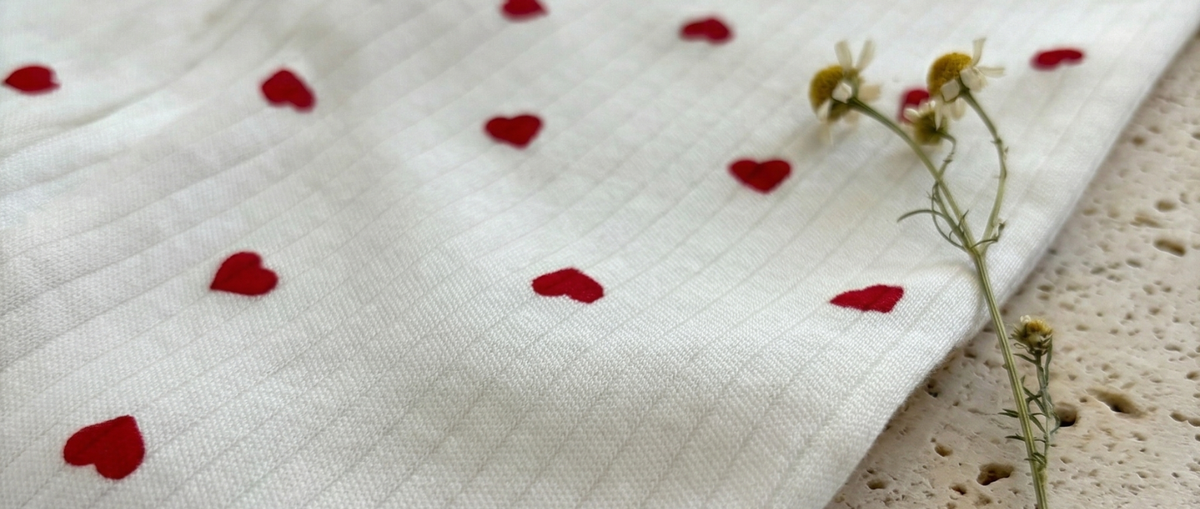
The way our pieces are built reflects the same considered thinking. Our cotton essentials use a rib-knit construction that alternates face loops and purl loops in vertical columns, giving comfortable stretch through the structure of the knit rather than a high proportion of synthetic elastic. The pristine Velvet Heart Romper drapes gently around your baby through this natural mechanical stretch, with no rigid pressure points, and like the rest of our cotton range it is certified to OEKO-TEX® Standard 100, Class I.
A well-made garment also helps keep a baby comfortably warm, which matters because newborns have a limited ability to regulate their own temperature and cannot yet shiver to generate warmth, as discussed in clinical guidance on the physiological mechanics of newborn thermoregulation and in clinical data regarding neonatal skin physiology and thermal dynamics. The gentle air pockets within our rib knit act as a natural, breathable insulator, helping a baby stay comfortably warm in cooler moments while still letting humidity escape as the room warms up.
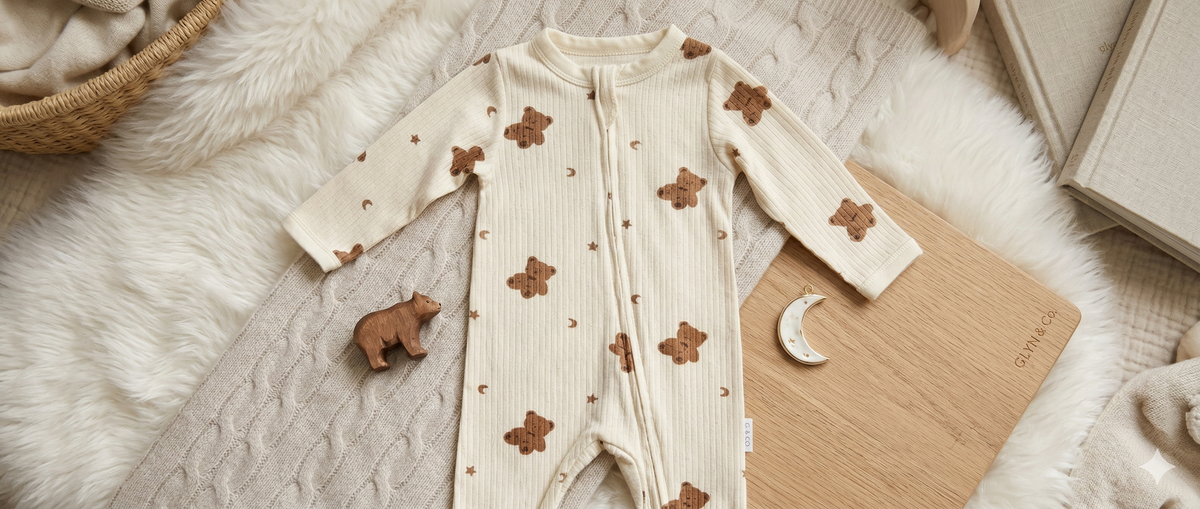
Our signature heirloom Vintage Bloom Romper shows the same approach: a clean, tailored silhouette in a soft cotton rib that holds its shape through long days of wear, certified to the same Class I standard. You can browse the full range of our signature curated rompers to find the pieces and tones that suit your nursery. Whichever you choose, the layer closest to your baby has been independently tested, which is the reassurance we most want to offer.
Organic vs OEKO-TEX Standard 100, at a Glance
| Property | What It Covers | Parent Peace of Mind Implication |
|---|---|---|
| Organic Certification | Primarily regulates how a fibre is farmed: soil management, crop rotation, and restrictions on synthetic pesticides and GM seeds. | Speaks to environmentally responsible cultivation and the world our children grow up in. |
| OEKO-TEX Standard 100, Class I | Independently tests the finished garment, including the base fabric and sewing threads, against the standard's strictest limit values, set for items intended for babies. | Speaks to what is present in the fabric that will actually sit against your baby's skin. |
| Point in the Journey | Organic looks at the growing stage; OEKO-TEX looks at the finished textile after spinning, dyeing, and finishing. | The two are complementary, answering different questions about a textile. |
| GLYN & CO. Current Range | 100% cotton essentials and a 95% bamboo viscose, 5% spandex Canvas Collection, both certified to OEKO-TEX® Standard 100, Class I. | Finished-garment testing for the layer closest to your baby, described honestly. |
Quick Answers
What is the difference between organic cotton and OEKO-TEX Standard 100 certified baby clothing?
The difference is what each certification looks at: organic certification mainly regulates how a fibre is farmed, while OEKO-TEX Standard 100 independently tests the finished garment against strict limit values for substances of concern, with Class I being the strictest tier for items intended for babies.
- Organic looks at the farm: It governs cultivation, soil management, and pesticide use during growing, which is meaningful for environmental responsibility.
- OEKO-TEX looks at the finished garment: It tests the completed textile, including base fabric and sewing threads, against the standard's limit values, at the stage that actually touches the skin.
- They are complementary: The two answer different questions, so neither replaces the other; together they describe both how a fibre is grown and what is present in the finished fabric.
A Closing Note from GLYN & CO.
The labels on baby clothing can feel like a language of their own, and a little clarity goes a long way. Organic and OEKO-TEX are both worthwhile, and understanding what each one actually means lets you choose with confidence rather than guesswork. We believe in describing what we hold plainly and honestly, so the reassurance we offer is real.
The philosophy of GLYN & CO. is an invitation to slow down and trust your own sense of what feels right for your family. You bring a quiet wisdom to caring for your child, one that values lasting quality and honest design over passing trends. Wrapping your baby in our certified cotton essentials offers a soft, breathable, independently tested layer in calm, neutral tones. Let us welcome the quiet luxury of intentional design, and create a peaceful space where comfort and calm come first.